The load meter was a plug in to the VFD, using an output from it, but since it’s not offered for any newer machines, probably doesn’t work on them.
The lathe (mine, OP didn’t say which he has) has an encoder sensor for threading, so in theory PP could detect under-speeding and stop, but IME on the 1100MX, it doesn’t trigger until the spindle gets very far below commanded – broke a 3/8” carbide endmill before it triggered last time.
I have been looking into this. Do you have the vendor (non-Tormach) part number for the VFD on yours? I was trying to see if it can be captured and displayed in PP like they now have a provision for in the newer mills.
I sold my Series 3 1100, but it had a Emerson Commander SK VFD.
IIRC you can set one of the output terminals to output 0-10v voltage based on motor load and that was sent to the meter display. It never was in PathPilot.
The newer drives might communicate that too, but I’ve not looked into it.
My 15L is a very early one so I wouldn’t count on anything it’s got being current issue.
I have a 440 and actually started to research the BLDC control for it for this project a few days ago. I was thinking that it would be nice to have a numerical representation of the motor load as opposed to just having the auditory feedback and this might be especially helpful for newer operators who haven’t developed the sense of feeds and speeds and cutting performance, given it seems to be a broad window of cutting “successfully” until a stall condition is about to, and then fully develops on some of the lower powered machines.
I’m sort of surprised that this function isn’t built into more CNC controls much like we have oxygen sensor feedback for the internal combustion engine to be able to dial in the fuel delivered for air ratio as it operates. It seems like 3-D printer land is leading the way in terms of controls and having an advanced enough processor on the machine controls to enable AI to be able to be in the feedback loop and ensure that there are fewer failures in execution of machine code.
If anyone else is interested for their platform, and has this information, feel free to comment in here (aside from the 1100 series that had the meter as an option) and maybe a general solution can be developed from mine.
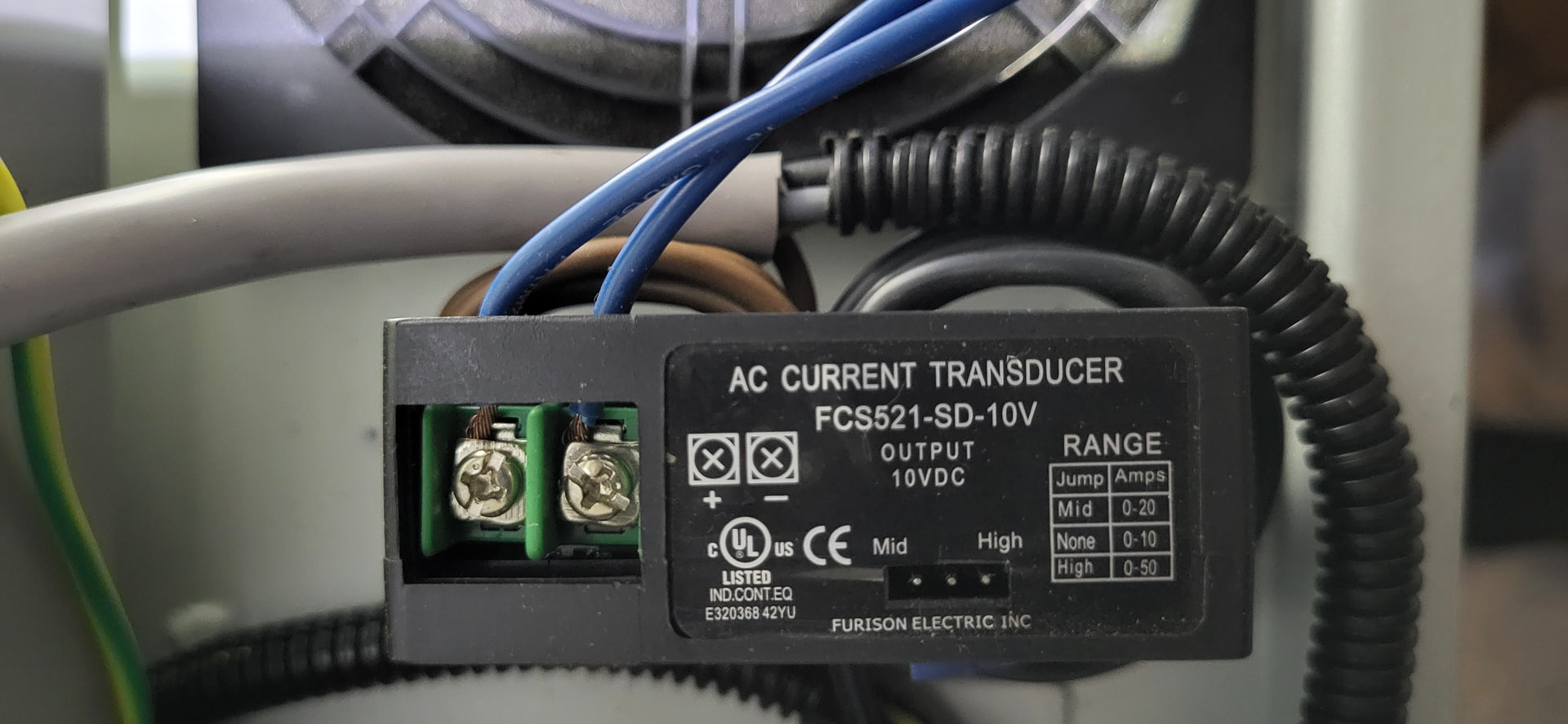
I was a little miffed the 770mx didn’t have at least an add on meter. So I added a current transducer and bought tormachs meter.
You basically wrap 1 phase through the magnet. 2 other wires feed the meter. It took a a little trial and error to get the number of winds right and it’s not exactly calibrated to the meter. But I have it close enough so I know when I’m approaching full load. By all rights you probably don’t need to or shouldn’t operate at max load continuously. These machines don’t like it.
I started out with a more sophisticated approach that hasn’t quite worked out (still debugging/researching it) but in the meantime, I tried something more basic to just to get some preliminary data.
This type of device seems to be universal and it works but the display seems to lag a bit, so the verdict is still out on the utility since I’ve only run a short program on it to be able to see how to try and adjust programming of feeds/speeds to extract maximum reliable MRR.
It’s a minimal investment and I only have it temporarily connected as shown. This needs to be mounted to the electrical enclosure panel as it powered by 110V into a screw terminals or has to have armored cable and be put in a proper enclosure like the reset/e-stop is on the 440.
Huh
Yeah, torq is limited, either high speed lighter cut or low speed heavier cut.
On my 770mx i tend to cut 4k to 6k rpm, depending on mill diam. Seems safe and sane, machine doesn’t complain, doesn’t stress too much.