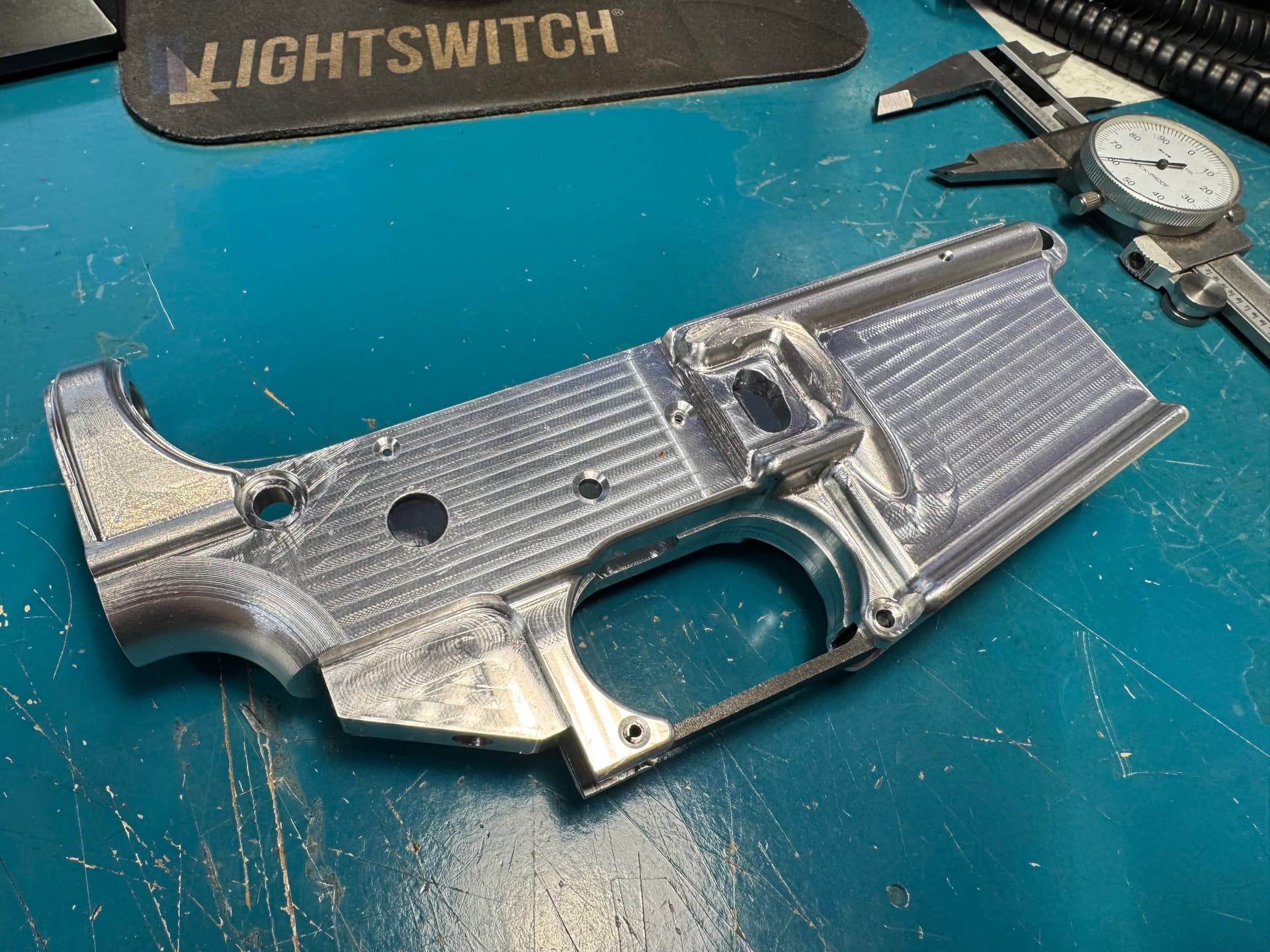
Hey All, I wanted to share some pics of my 1St airsoft AR-15 lower prototype and thank you all for the input for those who posted on my threads you guys have been a big help getting me over a couple humps, especially the Micro Arc Set up.
To recap the project this is a 3 Op part and the most complex part I’ve ever machined, even compared to all the milling I did as a toy sculptor, model maker and prototype creator for the toy industry for 20++ years and all that was organic toy sculptures and model parts.
· Op1 from billet in SMW mod vice,
· Op2 in my custom fixture that bolts to my SMW fixture plate,
· Op 3 is all indexed Micro Arc work.
As you can see we assembled the gun, tested it with the part and it worked flawlessly, So Im pretty stoked about that! We still need to field test it in real battle (airsoft that is) to make sure were are truly good to go on function. Im currently working on optimizing my programming to make prototype #2, cut down on mill time and gear up for our production of these.
I do have several things that need improvement on the top side 4th axis rotation, but im getting there.
Looks good! However, as a licensed manufacturer, I should caution that if it will work with ‘real steel’ AR parts, it would likely be considered an unlicensed machine gun in the USA due to the auto sear hole. A number of expensive Airsofts were seized and destroyed for that reason by Customs several years ago.
Seems like no matter what, when you go down the AR gun path, this all comes with the territory, right? We did consulted a lawyer on what we plan to do, and since we are only providing parts and not manufacturing working fire arms we are good and within the bound of the laws that define all this. The fact that an airsoft lower will not accept a real steel magazine or internals makes it impossible for someone to buy our product (parts only) and make a real gun from it as we have provided it. The magwell on an airsoft lower is dimensionally incompatible to fit a real steel magazine. My son as a real AR as well as tons of airsoft guns and we have tested this for our self’s. After the sale of it, if someone decided to customize into a real firearm it is out of our hands and we are not liable.
Yeah, that’s not quite how ATF works in my experience (company has an 07/02 for decades). Blocking real-steel parts is the key. If that lower fit them, even without any other AR parts it would be treated as a firearm receiver which requires licensing. But, since they don’t fit, you’re most likely ok. Best of luck with the project.
Roy which part of that do you have issues with? If I understood your first comment you said
“I should caution that if it will work with ‘real steel’ AR parts, it would likely be considered an unlicensed machine gun”
Bill says it physically is incompatible in some number of ways. If that’s the case why is it still a problem or is it? I’m not challenging you, I’m trying to understand…
I said that before he said the parts don’t fit, but ATF takes a very dim view of “easily converted” items and the “third hole” on ARs is particularly touchy with them. They’ve gone after engravers that just engraved a little circle to look like the end of the auto sear pin on semi-auto replicas under the theory it was a ‘drill here’ mark (yes, everyone knows it’s trivial to put that hole where it belongs without such, but they didn’t care)
Airsoft makers, especially overseas, have customer demand to make things as ‘real’ as possible and that’s gotten them in trouble with ATF before.
As an 07 manufacturer and D.O.D. research firm, I caution you to refer to the following link for clarification. First hand experience: we submitted a FDM model of a lower receiver containing no fire control well cavity, printed in sparse internal support, to the NFA Technical Division in Martinsburg for evaluation of a non-fire control feature and were issued a letter of the sample submitted being a completed firearm to be registered or destroyed. Problem was the marking of the fire control locating holes.
Would you please talk more about the tooling and toolpaths you used for the magazine cavity? I have generally avoided traditional AR lowers due to this section usually requiring broaching. But it seems like you didn’t do that so now I’m curious?
For the magwell, when I modeled the lower I kept in mind all the corner radius and modeled them to match up a particular drill diameter, 3/16 for the magwell. My process was to drill out the corners first, then go in with my ½ 3FL for adaptive roughing, from both top and bottom. I overlapped all my top to bottom tool paths by .03. For these parts I’m not super concerned IF I end up with a slight step inside the magwell as it will not effect function and any small step will kind of simulate the seam an airsoft forged lower would have and were ok with that. I then went in with 3/8 adaptive with rest machining, ¼ contour. This 1st prototype has very small cusp left over at the edge of the 3/16 corners which I intend to address in the 2nd prototype.
I’m fairly new to mechanical parts machining in metal but not CNC milling in general. I’ve posted many questions on Practical Machinist and have learned ton of stuff from the guys on that forum doing metal work every day on real industrial machines. Many of them have said I should be broaching that, BUT I mean how are we ever going to get started IF we go that route. Cost of broaching is out of our reach at this point. The broaching tool itself is a big investment. Although the depth of this is very challenging it is still doable, I’m still working out the kinks in my process, programming and machining. I hope to have it pretty well dialed after prototype #2.
After spending 20+ years in the toy industry as a toy sculptor, model maker, prototype creator, 3D modeler, CAD and digital artist, I was one of the 1st people in the toy industry doing work digitally as far back as 2000. I used CNC milling in my process to mill toy sculptures, models and prototypes. I’ve done a lot of very deep and challenging machining and most of it was in toy sculpting wax. Metal work is a totally different animal and has its own set of challenges. The biggest is what we all know as metal workers, tool deflection resulting in side wall chatter which I’m working through right now. The trigger box pocket and buffer lock pockets are way more challenging because I need to get down to a .05 corner radius so the mating parts will fit in these pockets. I just got a new round of necked, long reach, short LOC tooling that will be better than the previous tools I’ve used on this one.