I’m looking for some assistance in programming a small part on my 440. Attached is the fusion file for a small crank case bearing block for a steam engine I’m building.
I’ve been having difficulty on my 440 boring the centre of the bearing block. I’m initially trying to run a 4mm drill down the centre, then following up with a 6.5mm drill, and finally using adaptive clearing to open the bore up to 12mm.
The issue I’m having is that the drills in the 1/4” chuck keep jamming in the hole, both 4 & 6.5mm, and stops the spindle, I’m terrified that I damage my mill in this manner.
I’m a complete novice, can someone review my CAM programming and offer some assistance, would it be better to bore the hole using a 3 flute end mill instead of the drills, if so what speeds and feeds should I be running.
Being from the UK, we don’t use that witch craft called “imperial:… , so I’ll apologise now but I work in the real stuff “ Metric”…
I can’t open your file here, but what speeds and feeds are you using with the drills? Are you peck-drilling (Fusion calls it ‘full retract’ and ‘chip breaking’ cycles I think-- try full retract if you haven’t)? Using coolant? What material are you cutting?
In general, drills of reasonable size will remove material much faster than an end mill, although the holes might not be quite the right size or in quite the right place.
440 is going to be torque limited. Pecking cycles for larger bits. David Loomes has a few videos showing drill cycles for you to get an idea of what sizes and types of cycles.
We have all probably stalled our machines like that but best to program appropriate feeds and speeds. FSWizard snd HSMadvisor are helpful.
12mm final depending on depth may be easier to bore with a smaller end mill spiral entry to an undersized bore to step your way to a critical tolerance for the actual final bore with an offset without a boring bar (NYC CNC has covered this).
Thanks for the feedback guys, I’m cutting aluminium and I’m using a mist coolant, I’ve added the full retract and will run the part again shortly, I’m drilling all the way through a 38mm piece of stock, I’ll also give the hole a squirt of WD40 and see if that helps any.
You’ll need an endmill with more than 38mm of flute length (or reduced shank) and preferably as large as will fit. IDK if the Fusion ‘boring’ tool path does spiral holes or if you just want to do that with a Pocket op.
Generally my workflow for large, deep holes is as follows:
Predrill - not specifically needed but helpful to allow chips to clear through the bottom as the hole gets deeper. LOTS of coolant, short peck depths to break of the chips and reduce torque requirements. Probably no more than around .05mm chip per tooth (.1mm per revolution) unless you want to change the belt to the low position for more torque
Rough - 2D adaptive with a helical entry. DOC and WOC will vary depending on the tool you’re using. I’m much more familiar with speeds and feeds for the 1100m than the 440 so I can’t really advise too much here but with a 6mm-ish tool, 3-6mm DOC and 1.25-2 WOC should be a good starting point. 10k RPM, and .025-.05mm chip per tooth to calculate feed rate. Not sure of the spindle torque curve so you could try a lower RPM as that might gain you a bit more torque and allow for a deeper cut, but especially with longer tools, I find higher RPM and lighter cuts results in a better surface finish/less chatter. Leave .25-.5mm of stock on the walls for the cleanup pass.
Finish - 2d contour or circular or bore, in that order. I find bore is helpful in some circumstances but then you have to think about helix angle. Circular and contour are effectively the same in this application, so no real difference between them. 38mm is a pretty deep cut for a 440 even with only .5mm of radial depth so you could try doing it in one pass but I would suggest multiple depths. At least 2, maybe 3-4 depending on your results. I would also suggest adding a spring pass AND a bit of overlap between the entry and exit points. The spring pass will handle the minimal tool deflection and get you closer to the target diameter. The overlap will avoid the tiny witness mark that is often left behind whenever the tool starts and stops in the same spot. You will need a tool with at least as much flute length as the hole depth, OR something with a reduced shank, otherwise the shank will rub on the top of the hole as you’re finishing the bottom. This usually can be cleaned up with a light buffing after machining but the right tool will avoid the problem all together.
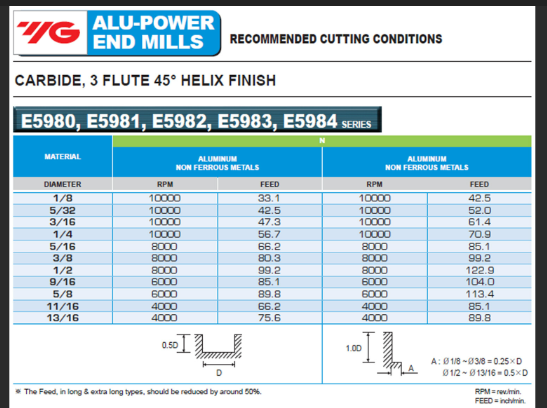
NYC CNC, youll prolly find a lot more informative views on there than here, since hes showing you in the videos optimizing the toolpath, has helped me a lot when i started with my 770M, I went from running a haas ec400 (big boy horizontal) in school to the 770 so it was kind of a backwards learning curve for me. He has a good bit of vids using a 440, 770, and 1100. PS, if you want cheap tooling right now get the emills off haas, there just rebranded YG1 Alupower emills. I run 3/8 tools normally and i can get 1.5MRR, I know i can get more out of them yet, but this is what id be comfortable with for a long period of cut time. And you can get almost mirror finish. By the way, the feeds and speeds do have to be adjusted, but i would start with light radials on some scrap pieces at 1XD axial, and run the speeds and feeds listed and go from there. For example, i run 3/8 emill at 80ipm, 1XD, axial, and .05 radial, 1/4 Emill at 60ipm, 1XD axial, .04 Radial, 1/8 Emill at 40ipm, 1XD, .025 Radial.
 , so I’ll apologise now but I work in the real stuff “ Metric”…