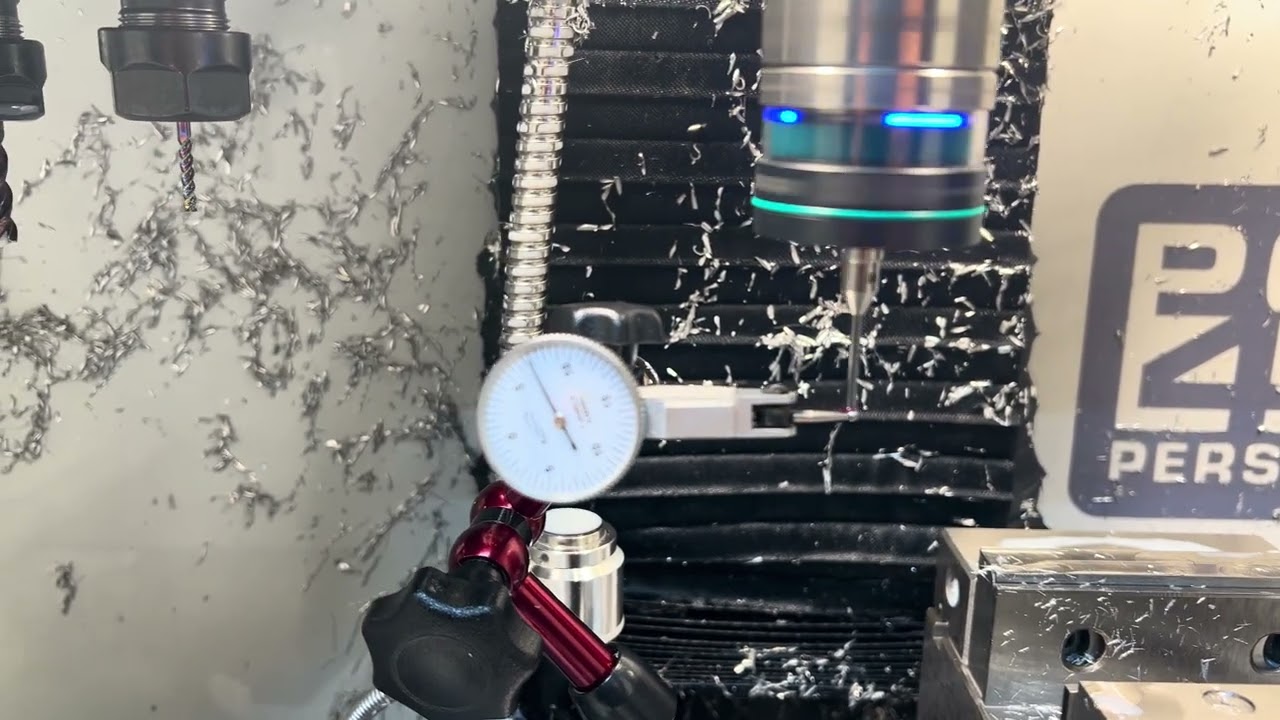

Very cool. I didn’t know there was a wireless probe for the 440.
Wow! BANG ON! Solid work
I know you mentioned this probe a while back
What is it again?
It is sold as a “GP-800”. My understanding is that it is an attempt to clone a Renishaw without it looking 100% like one. You give up some of the top-end range of precision/accuracy. There are Renishaw clones (which very well be off the same production line) but the cost was higher than this (over double). Those may be for someone who wants better repeatability than the 0.001mm this is rated at. For a 440, this seemed like an appropriate match.
The weak point others that have pointed out, is the battery life, which I think are folks who leave the machine on and don’t have something to control the probe “wake-up” input while the machine is on and the probe is not actively being used. I have the USB I/O board accessory. If you install and configure the appropriate Xoomspeed add-on scripts, it will control the “wake-up” wire, which allows the probe to go to sleep and conserve battery unless Tool 99 is selected. Keeping the probe asleep also ensures it will not trip while machining. I’ve seen it trip from handling/vibration.
Also of interest and for reference, I eliminated the solid state relay, as I occasionally got “probe is already tripped” errors and was thinking that removing that extra component might help narrow things down. I am still working out what I may be pushing the limits on in terms of probing or minor configuration issues, as I still occasionally get them during routines that have many probe moves in rapid succession.
You MUST independently verify with a multimeter your specific machine control input circuitry but on the GP-800 probe, which does not have a contact closure output, I am able to use GND and +24VDC to power the receiver. On my revision of GP-800, the default dip switch for the output green wire is setup such that the green output wire “skip“ is effectively read as NC when connected to the control input pin that is pulled up to 24VDC on what is normally a contact closure input that expects to be closed to the other pin (which reads as ground).