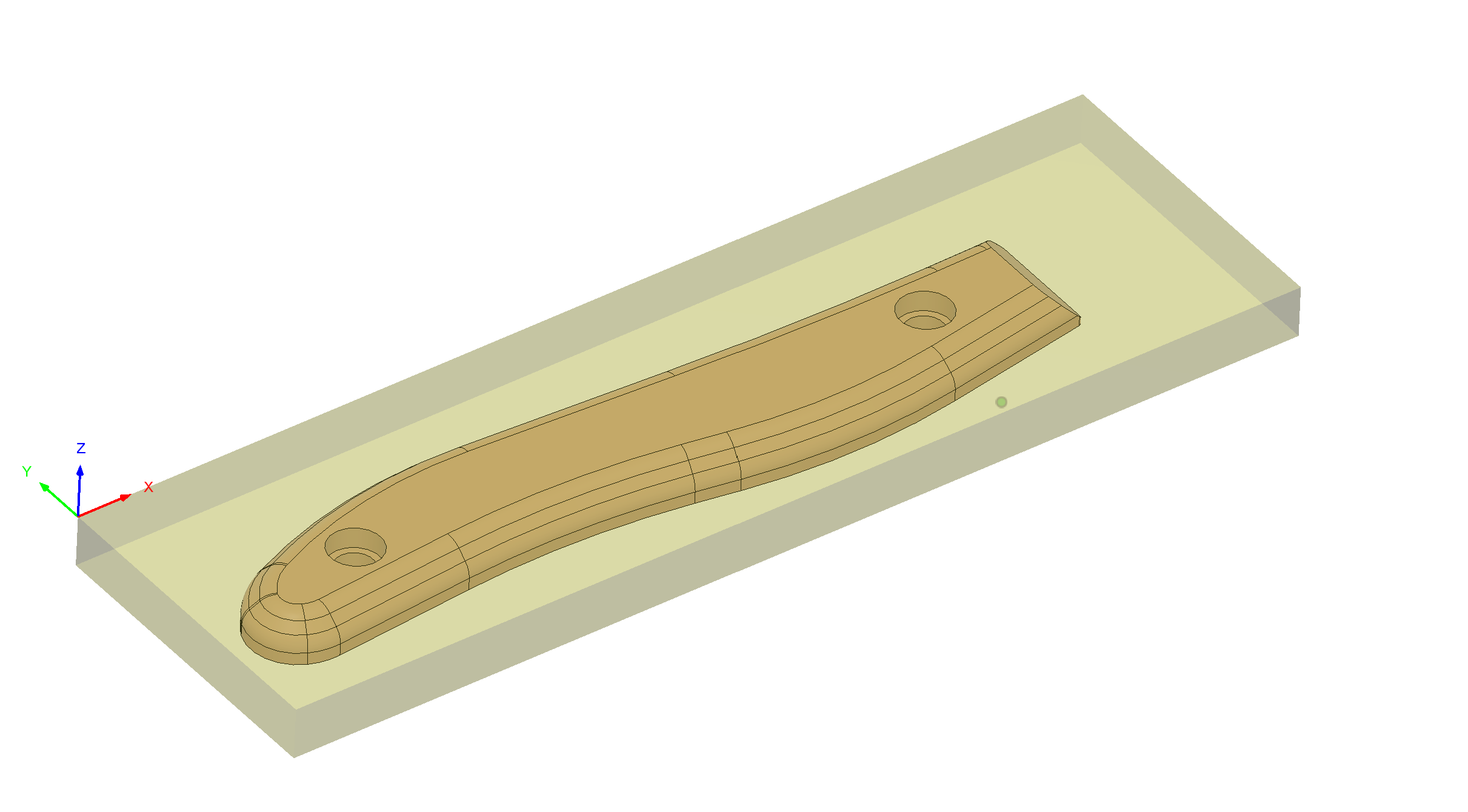
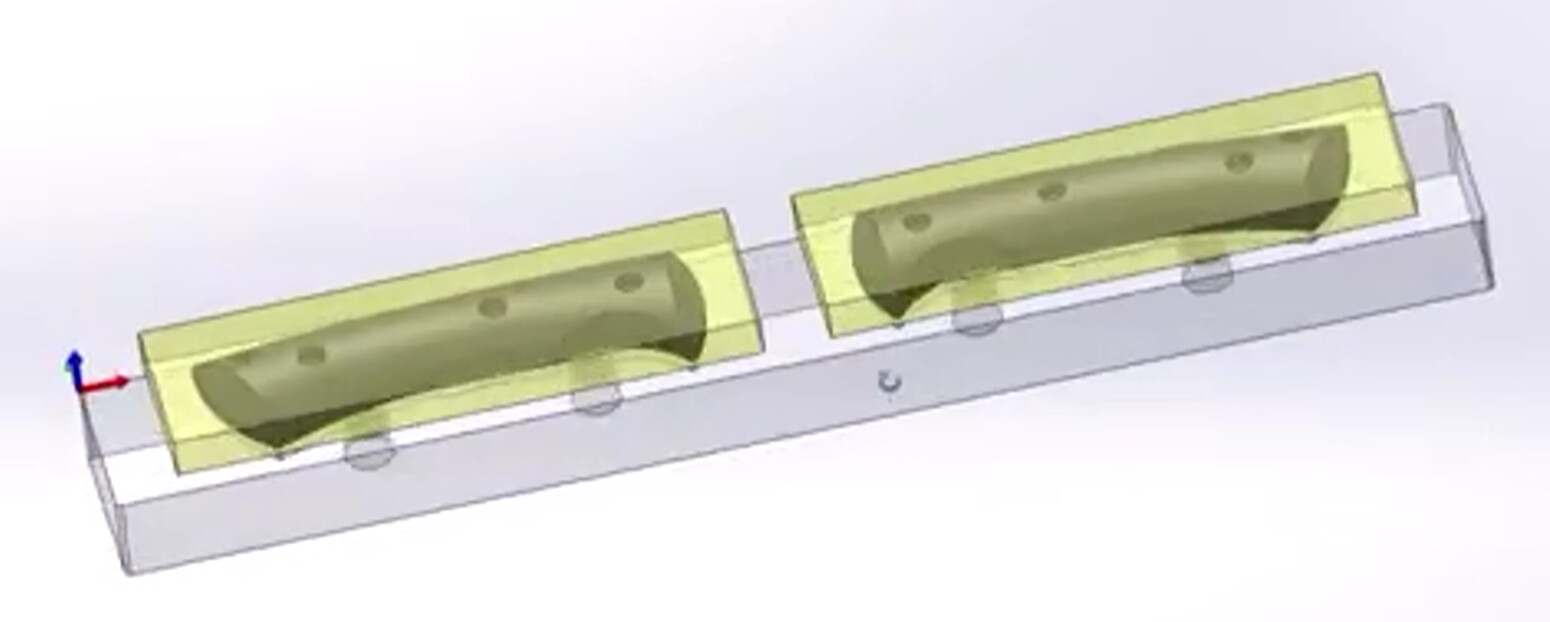
I have limited experience with ball and bull nose end mill selection. The knife handle below will be sitting up on a pedestal and screwed from below to hold it in place. The pedestal will allow the ball or bull nose end mill to reach the bottom leading edge of the knife handle. See examples below. I happen to have a 1/2-inch ball nose end mill and a 1/2-inch bull nose end mill with a .030 radius. I watched a video with similar project, and they used a 1/4" bull nose end mill with a .060 radius to machine similar geometry. Two questions:
- What is the best way to determine the correct tool for this kind of geometry?
- Do you think the 1/4" bull nose with .060 radius is a good fit?
- I plan on using a 3d adaptive to rough out the shape. Would the 1/2" bull nose with .030 radius work well for this?
- If you were using Fusion, what 3D tool path would you suggest for finishing this kind of shape?
Thanks… Richard
My knife handle:
Similar Knife Handle Fixture:
Fusion File:
CAM NWPairng.f3z (3.0 MB)
Bullnose mills are great for roughing, especially harder materials, because the corner radius eliminates the sharp corner which is the weakest part of the tool. They can also be used for surfacing in some situations, but aren’t the best fit for that. The downside to bullnose tools is that they leave a radius where the floor and wall meet whenever you’re cutting an interior pocket. Sometimes this doesn’t matter, sometimes it does.
Ball mills are pretty much the only option for surfacing in a 3 axis setup (tapered ball mills work too but are kind of pointless without a 4th or 5th axis). The larger the diameter, the smoother the finish with fewer passes. But larger diameter tools can’t get into small details. Small diameter tools work just fine but require a smaller stepover to get the same surface finish as a large tool and often don’t leave as nice of a surface, even if it is technically the same RMS value.
As for your specific application. Assuming these handles are wood or plastic, the specific roughing tool you choose is largely irrelevant. Even in aluminum, tool selection isn’t going to matter all that much. All of those materials are soft enough that any quality carbide tool is going to chew through them without any issues. Steel/Titanium/Stainless are a different story and will require a bit more careful tool selection. For any of those, the 1/2 tool is probably too big for the available torque of your machine unless you take light cuts.
The finishing tool is also not that critical. Use the biggest tool that will fit into the features. If a 1/2” ball fits, then it will work. If it doesn’t fit, you’ll need to get something smaller. Either way, the ball mill isn’t doing the heavy lifting here so the diameter is less important from the perspective of the machine’s capabilities.
Lastly, the toolpath. There are several options and all would work. For a beginner, I would suggest the parallel tool path. It is fairly easy to setup and control and generally does a good job of leaving a nice finish. Contour and scallop will also work but my experience with them on surfaces that are close to flat is the finish ends up being rather poor, mostly due to the excessive use of the center of the ball mill which isn’t the best use of that type of tool. There are others like blend, etc. but those can be difficult to get set up, especially for someone just getting started, so I would leave those alone for now.
You can use router bits as well. You might find just the right profile router bit, and wood router bits for rounding over are a lot cheaper than corner rounding end mills.
Wow… Ian, you are a fountain of knowledge! Thanks! Harold, that is a great idea as I have a number of router bits.
Lots of knife handles are made of G10. I don’t want to machine it as I don’t want the abrasive material in my machine. Instead, I will be using polyester and acrylic resin-based materials. The stock is held in place from screws below, and I don’t think the threads will hold as well in these materials as G10, so I plan on taking light passes.
I think I will try rouging with my 1/2-inch bull nose and .03 radius and finishing with the 1/2-inch ball nose. I’ve used the parallel tool path before so thanks for the suggestion.
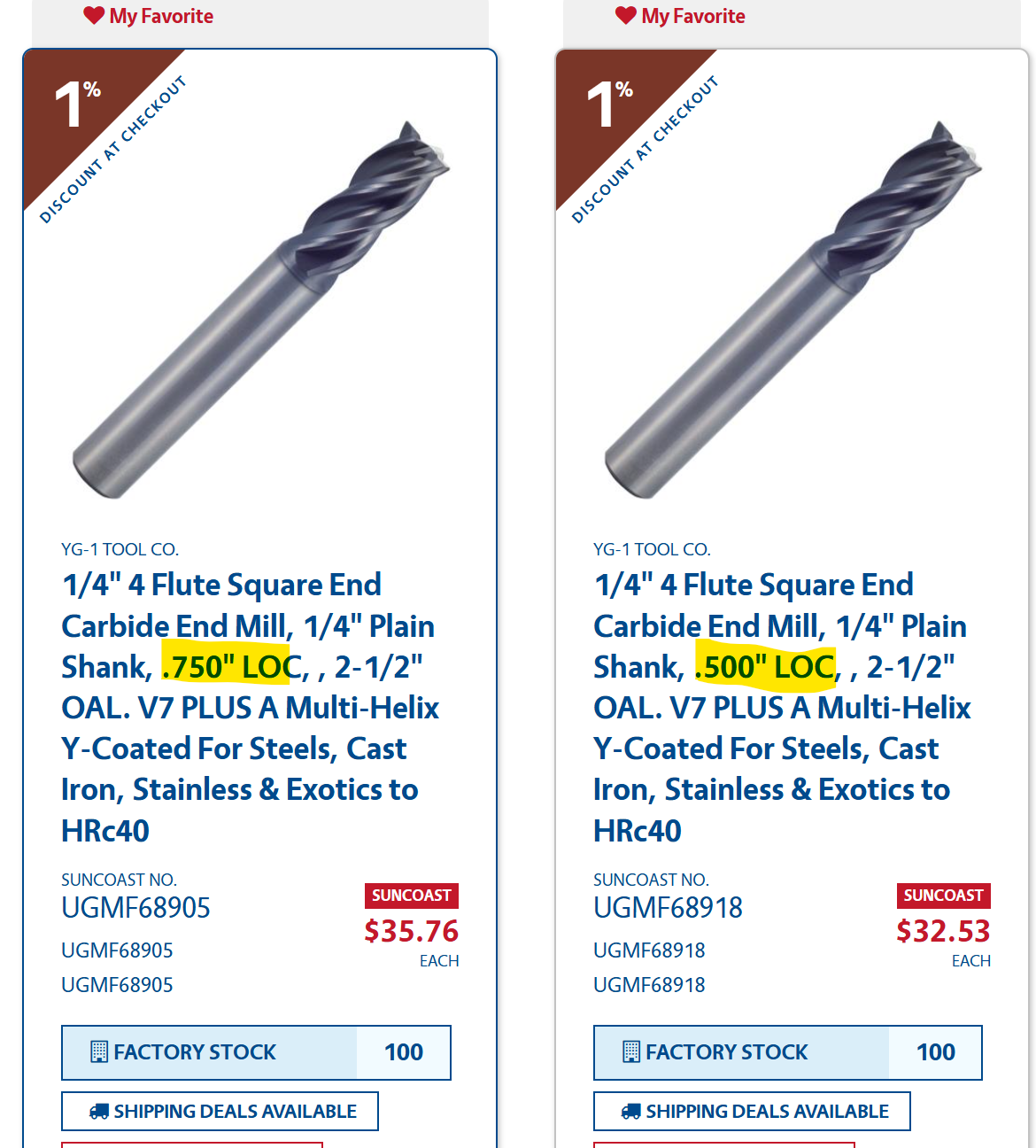
One last question. Knife blades are typically less than .125" thick, and I am told that the shorter the end mill the better. As a hobbyist, I never know what I am making next, so I prefer to buy slightly longer end mills. If I am cutting profile of a blade, I would probably cut half depth then full depth for roughing and full depth for the final pass. Since I can bring the tool below the part on any full depth cut, is there really any advantage for me to buy a .5 LOC or .375 LOC instead of buying a .75 LOC and have it for whatever else I plan on machining?
At 1/4” I don’t think it makes a difference. Those V7+ are what I use and they are so incredible. But make sure you use coolant for stainless. Unless you like melting steel.
Thanks Harold… Coolant it is!
+1
For YG-1 end mills
Only thing I use in AL
However you are right in thinking shorter is better
Consider a stub EM for your work
Thanks… For now I ordered. 75 loc. If I really get into knife making… I’ll grab some short ones. I just never know what I’m making next.
Thanks… Richard
I had some challenges setting up the 3D finishing tool paths. My buddy on the Fusion CAM forum had some helpful info. Here it is in case you folks are interested:
Re: 3D Parallel & 3D/2D Adaptive Question - Autodesk Community
Best… Richard