Earlier this year I purchased a 770MX. This mill controls the MicroArc 4 with an EtherCAT MX 3660 driver. When I received the mill, the MicroArc 4 would not properly execute G0 Axxx commands. For example, when a G0 A90 command was executed, the MicroArc would move between 5 and 30 degrees, stop moving, and would generate a binding noise. I reached out to Tormach support and they sent me replacement pins for the MicroArc connector. I replaced the pins and unfortunately, the problem remained. Tormach support diligently attempted to resolve my issue, but unfortunately, they were not successful. Thus, I began the following experiments in an attempt to resolve my issue.
Using an IR thermometer, I determined that the housing temperature of the MicroArc 4 connector was 139 F, which was 69 F above room temperature when the MicroArc was static for at least 8 hours. When I inquired with Tormach support about the connector temperature, they responded “Regarding temperature, I’m not sure if 139 F is above normal as these do run a little warm mostly due to the motor holding it’s position while sitting idle.”
Based upon advice that I found on the Tormach forum, I applied conductive grease to the pins in the MicroArc connector. Again, using an IR thermometer, I determined that the housing temperature of the MicroArc connector was 96 F, which was 26 F above room temperature when the MicroArc was static for at least 8 hours. Thus, the conductive grease reduced the connector housing temperature increase by 43 F (from 69 F to 26 F). After applying the conductive grease, the MicroArc properly executed G0 Axxx commands most of the time. However, the MicroArc did fail to execute G0 Axxx commands occasionally. Thus, I did not find that conductive grease was a reliable solution to my issue.
Next, I tried replacing the MicroArc connector pins and sockets with gold-plated pins (Digikey A25123-ND) and sockets (Digikey A251243-ND). Again, using my IR thermometer, I determined that the temperature increase of the connector housing was only 2 degrees when the MicroArc was static for 24 hours. Importantly, after installing the gold-plated pins and sockets, the MicroArc has always properly executed G0 Axxx commands.
A photograph of the gold-plated pins and sockets (far left), unused Tormach-supplied pins and sockets (middle left), and used Tormach-supplied pins and sockets (far right) follows.
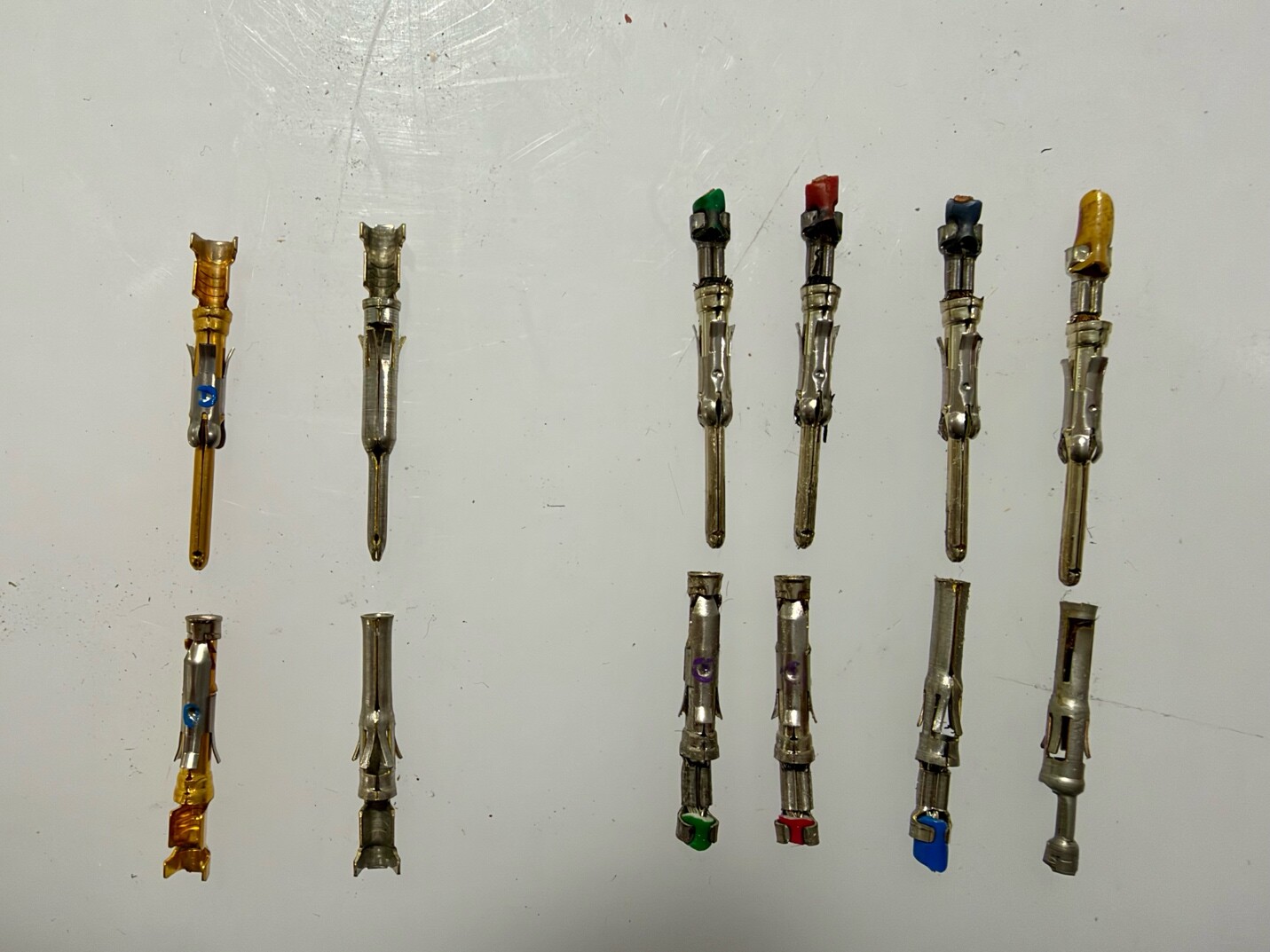
One can see that the plastic wire insulators the right have discolored due to heat. In addition, one can see oxidation on the pins and sockets on the right. It may be that this oxidation is causing an increase in resistance which generates heat at the pin/socket interface.
While there may indeed be something unique with my mill that has caused the above-described issue, I wanted to pass along the results of my experiments on the MicroArc connector in case anyone else had similar issues. To summarize, replacing the original Tormach pins and sockets with gold-plated pins and sockets resolved my MicroArc 4 issue.
Hoyt